  1. Tags/

Dotnet

Error installing the Windows Azure AppFabric Tools for Visual Studio (CTP)

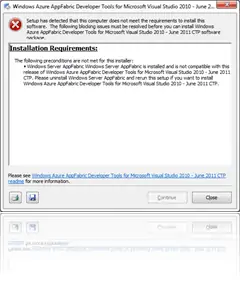
When installing the Windows Azure AppFabric Tools for Visual Studio (found here), you might get the error message shown at the top, stating that Windows Server AppFabric is installed and that it is not compatible with this release of Windows Azure AppFabric Developer Tools for Microsoft Visual Studio 2010 – June 2011 CTP. It asks to uninstall Windows Server AppFabric and rerun this setup if you want to install Windows Azure AppFabric Developer Tools for Microsoft Visual Studio 2010 – June 2011 CTP.

Using Crystal Reports in ASP.NET on a 64 bit machine

·2 mins

The above scenario gave me the well-known could not load file or assembly error message. The assembly that couldn’t be found was log4net, Version=1.2.10.0, Culture=neutral, PublicKeyToken=692fbea5521e1304. Or one of its dependencies of course… The situation in which I was getting this error message:

Little-heard-of ASP.NET feature: app_offline.htm

·3 mins

Although the feature has been around since ASP.NET 2.0, I still meet people that don’t know and/or use app_offline.htm. Do you know (and use) the feature…?

When working on an ASP.NET web application, you should notify your visitors in a decent way that your application is down. There’s a nice default feature available for these purposes since ASP.NET 2.0. Somehow, however, this feature is not very well known and rarely used. The App_Offline.htm feature in ASP.NET 2.0 provides an easy way to bring down an ASP.NET application while you make changes to it. This feature kicks in as soon as you place a file called app_offline.htm in the root of the application. When ASP.NET detects the file, it will shut-down the app-domain for the application and won’t restart it for requests. The app_offline.htm file will be sent as the response to all new dynamic requests for the application. When you’re done updating the site, just delete or rename the file and your site it will come back online.
“AjaxControlToolkit is undefined”

Because we were still using an old Visual Studio 2005 solution which included a Web Site project, it was time to upgrade. We upgraded our Visual Studio 2005 solution to Visual Studio 2010 (and .NET 4.0), converted the Web Site Project to a Web Application Project and then, of course, the AjaxControlToolkit had to follow. I downloaded the latest build from their Codeplex site and updated the references in the different projects. I ran the website, and that’s where things got ugly …

Fix available for IE8 asp:menu problem

·1 min

I just read an interesting article on Bertrand Le Roy’s blog. The most important information:

It so happens that the menu control is making a bad assumption on what the default value for z-index should be. We debated this at length with the IE team, but it became clear as we did so that they were right and that we were wrong. We had to fix that.

HowTo: Add a body onload script to a page that uses a MasterPage

·1 min

When you use a MasterPage to define the design of your website, you might come across the problem that there is no body element in a web content form. This can be a problem when you want to add an onload script to a specific page. You could of course add the onload on the MasterPage, but you might not want the script to run on every page. There are several workarounds to fix this ‘problem’. The one I used last week was to do the following: